
This post contains affiliate links to Bookshop.org. If you make a purchase through these links, I may earn a small commission—at no extra cost to you. Your support helps sustain independent bookstores and keeps this blog going.
Katabasis by R. F. Kuang – Chaos & Clarity
Genre: Fantasy, Dark Academia
Pages: 541
Rating: ★★★★☆
Buy: Bookshop.org
This post contains spoilers.
Book Blurb
Two graduate students must set aside their rivalry and journey to Hell to save their professor’s soul, perhaps at the cost of their own.
Alice Law has only ever had one goal: to become one of the brightest minds in the field of Magick. She has sacrificed everything to make that a reality—her pride, her health, her love life, and most definitely her sanity. All to work with Professor Jacob Grimes at Cambridge, the greatest magician in the world—that is, until he dies in a magical accident that could possibly be her fault.
Grimes is now in Hell, and she’s going in after him. Because his recommendation could hold her very future in his now incorporeal hands, and even death is not going to stop the pursuit of her dreams. Nor will the fact that her rival, Peter Murdoch, has come to the same conclusion.
My Thoughts
For the most part, I enjoyed Katabasis. One of my favorite elements was the blend of philosophy, religious history, and interpretations of the underworld. The book offers a scholarly exploration of hell that feels rooted in real academic conversation. However, at the same time, I became increasingly irritated by the repeated use of the word “interlocutor.” It appears so often that it pulled me out of the narrative. Once I noticed it, I could not unsee it.
Alice herself fascinated me. Her dysfunctional thinking is uncomfortable, erratic, self-contradictory, and strangely honest. I found myself drawn to her interior spirals. They give the book a raw psychological depth that kept me invested even in the moments where she frustrated me.
I also appreciated the representation of Crohn’s disease. It was integrated into the story in a way that felt grounded in real experience, rather than thrown in for dramatic effect. It shaped Peter’s life without defining his entire identity, and that felt meaningful.
Peter’s death was another moment that had me questioning what was meant to be literal. I kept asking myself whether he truly died or whether something metaphorical was happening. By the end, it seems clear he did in fact die and was subsequently brought back. The ambiguity around that sequence fits the themes of descent and return, although I am still not sure how I feel about the mechanics of it.
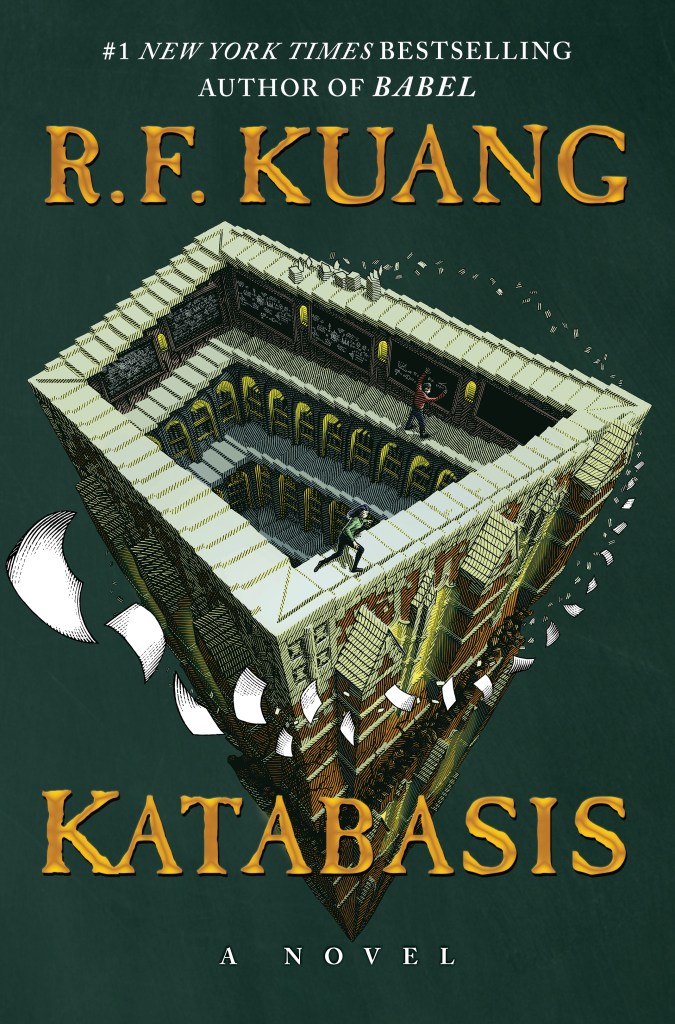
The imagery near the end is especially memorable. Alice’s dream of Professor Grimes with the pieces of his face arranged like a pencil sketch felt eerie in a way that lingered with me. The book is full of visual moments like this. Kuang has a talent for making scenes feel both surreal and cinematic, and this made the entire descent into hell strikingly easy to imagine.
Finally, Alice’s fixation on Professor Grimes left me unconvinced. I never fully understood why she was so enamored with him or why she consistently excused his behavior. The ending provided some satisfaction, because her final encounter with him strips away the illusion she has built around him. Watching her become completely disillusioned felt like necessary closure.
In terms of genre, I would not call this a romance. There are hints of romantic fixation, but the story has no real romantic arc. I also hesitate to label it as fantasy, at least not in the traditional sense. The speculative elements serve the philosophical questions more than they build a fully realized fantasy world. It is absolutely dark academia though.
I also understand why some readers disliked the heavy side notes and philosophical detours. In Babel, this kind of information lived in footnotes, so readers could choose to engage with them or ignore them. In Katabasis, the material is embedded directly in the narrative, which forces the reader to process it. I personally did not mind, because I am the type who always reads footnotes. However, if you tend to skip footnotes in fiction, you may find that these digressions interrupt the flow without adding much to the story.
Overall, I did enjoy Katabasis. I read it quickly and found myself engaged, although more for the intellectual and historical references than for the plot itself. This is similar to how I felt with Babel. It was only afterward that I made the connection that both novels are grounded in Oxford, which the author attended. Once I realized this, I found myself questioning whether the Oxford focus feels a bit self-referential. I am not sure it detracted from the book, although it did strike me as somewhat pretentious in retrospect.
Final Thoughts
Katabasis is a complex, ambitious novel that blends psychology, philosophy, and myth in a way that is both fascinating and uneven. I appreciated the intellectual depth and the vivid imagery, and I found Alice’s chaotic inner world strangely compelling. At the same time, the structural choices, the academic density, and the occasional pretentiousness may not work for every reader. For me, the experience landed somewhere between admiration and frustration, yet I ultimately enjoyed the journey. If you are a reader who loves philosophical tangents, psychological spirals, and stories that blur the boundaries between reality and metaphor, this book will likely keep you thinking long after you finish reading.
If you want to check out ‘Katabasis’ by R. F. Kuang, consider purchasing it through Bookshop.org. Supporting this link helps sustain independent bookstores and keeps this blog thriving.
Read Other Fantasy Reviews:
Our Infinite Fates by Laura Steven
The Courting of Bristol Keats by Mary E. Pearson
Emily Wilde’s Encyclopedia of Faeries by Heather Fawcett
Love what you’re reading here? Support the blog and fuel my next cozy reading session by buying me a coffee.
 Notes from the Shelf
Leave a comment