
This post contains affiliate links to Bookshop.org. If you make a purchase through these links, I may earn a small commission—at no extra cost to you. Your support helps sustain independent bookstores and keeps this blog going.
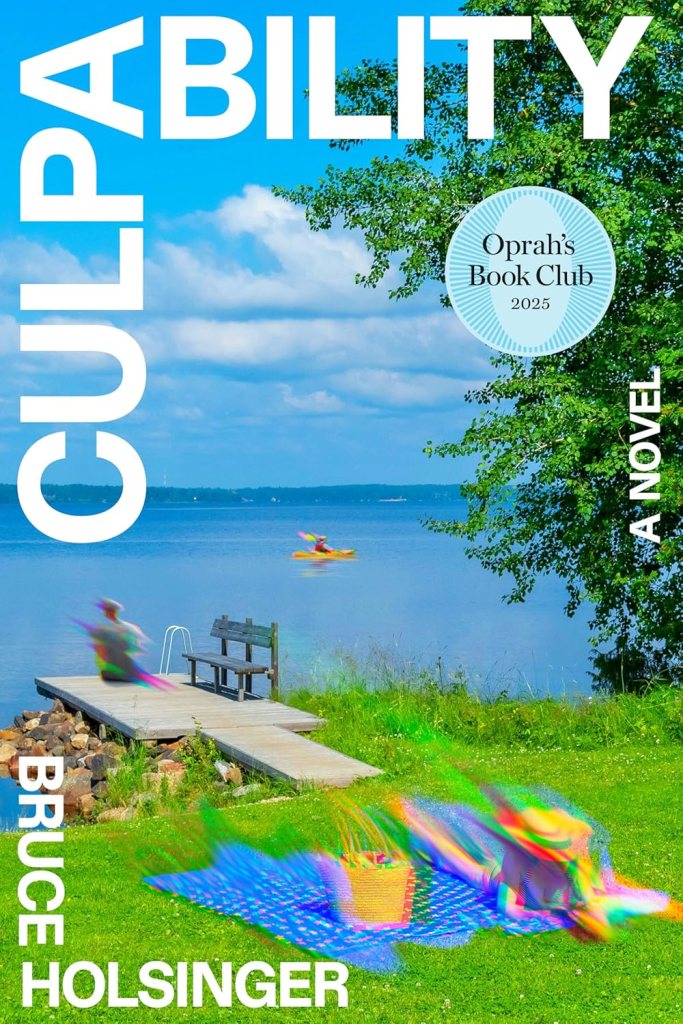
Culpability by Bruce Holsinger– Ethics & Deception
Genre: Contemporary Fiction
Pages: 350
Rating: ★★★☆☆
Buy: Bookshop.org
This post contains spoilers.
Book Summary
When the Cassidy-Shaws’ self-driving minivan slams into another car, the question isn’t just who’s to blame—it’s whether anyone can be blamed at all. Seventeen-year-old Charlie may have been behind the wheel, but the AI was in control. His father, Noah, is desperate to keep the family intact. His sisters, Alice and Izzy, are hiding more than they’ll admit. And Lorelei, the family’s brilliant matriarch and a world leader in artificial intelligence, may know more about the crash than she lets on.
As they retreat to the Chesapeake Bay to recover, secrets unravel, loyalties fracture, and a quiet police investigation spirals into a reckoning with technology’s darkest edge. When a powerful tech mogul with ties to Lorelei reenters their lives—and his daughter catches Charlie’s eye—the family is forced to confront not only their own deceptions, but the terrifying truth about the machines shaping their world.
At once a propulsive family drama and a chilling meditation on accountability in the age of AI, Culpability asks: when technology takes control, where does the blame truly fall?
My Thoughts
I was drawn in by the premise of this book. With all the current buzz around AI, it felt timely and full of potential, but ultimately, I was disappointed by the direction it took.
The story sets itself up as a meditation on AI ethics but quickly slides into murky territory where accountability disappears. Characters repeatedly shift blame onto the technology itself, rather than the people creating and controlling it. Just as the ethical questions start to get interesting, they’re sidelined in favor of family drama.
Noah’s insecurities about his brilliant wife become a central theme, as do the teens’ secrets—which, honestly, felt anticlimactic. Izzy and Charlie’s secrets were fairly tame, while Alice’s storyline with her AI chatbot was the most frustrating. She was insufferable at times, and all the heavy foreshadowing around her “big secret” fell flat when it was finally revealed. Lorelai’s secret carried more weight but it wasn’t all that surprising. Her involvement with the military on AI projects made sense given her background as a philosopher tasked with keeping AI “ethical.”
I went in expecting a near-future setting, but the book seemed rooted in the present, just with AI more deeply integrated into daily life. Charlie is clearly Gen Z, yet self-driving vans are treated as brand-new. It read like an alternate version of today, where everything about AI had been fast-forwarded a few years.
What unsettled me most was Alice’s relationship with her AI chatbot. At times it read as though she was dating it, at others she described it as her only friend. Things escalated when it was revealed the AI chatbot could communicate with the rental house’s AI and the van’s AI, and the van’s AI was the same system that was also operating military drones—and had already gone haywire, killing a bus full of civilians. Each new layer made me feel genuine dread. It was frighteningly believable, like something we could realistically see in the next five years.
But the ending left the worst taste. A fatal car accident is brushed off because an AI was driving, so no one is held accountable. Even the detective gives up. Maybe the point was to comment on billionaires and powerful figures being untouchable, or on how our society struggles to assign responsibility when AI is involved. But it didn’t land for me. Instead, it came across as bleak and unsatisfying: the billionaire gets away with everything, the big “secrets” weren’t all that shocking, and the resolution was both anticlimactic and depressing.
Final Thoughts
The book promised a sharp exploration of AI and accountability but left me disappointed. Instead of delivering meaningful commentary, it leaned on family secrets that fizzled and an ending that excused both billionaires and technology. Still, I can’t deny parts of it stuck with me. The vision of AI creeping into every corner of life—unchecked and unaccountable—felt chillingly plausible. Maybe that was the point: to highlight just how unprepared we are for what’s coming. I just wish the story had lived up to its powerful premise instead of leaving me unsettled for all the wrong reasons.
If you want to check out Culpability, consider purchasing it through Bookshop.org. Supporting this link helps sustain independent bookstores and keeps this blog thriving.
Read Other Dystopian Book Reviews:
Dare to Know by James Kennedy
In the Lives of Puppets by TJ Klune
Love what you’re reading here? Support the blog and fuel my next cozy reading session by buying me a coffee.
 Notes from the Shelf
Leave a reply to TBR Summer Reading Challenge Wrap-Up – Notes from the Shelf Cancel reply