
This post contains affiliate links to Bookshop.org. If you make a purchase through these links, I may earn a small commission—at no extra cost to you. Your support helps sustain independent bookstores and keeps this blog going.
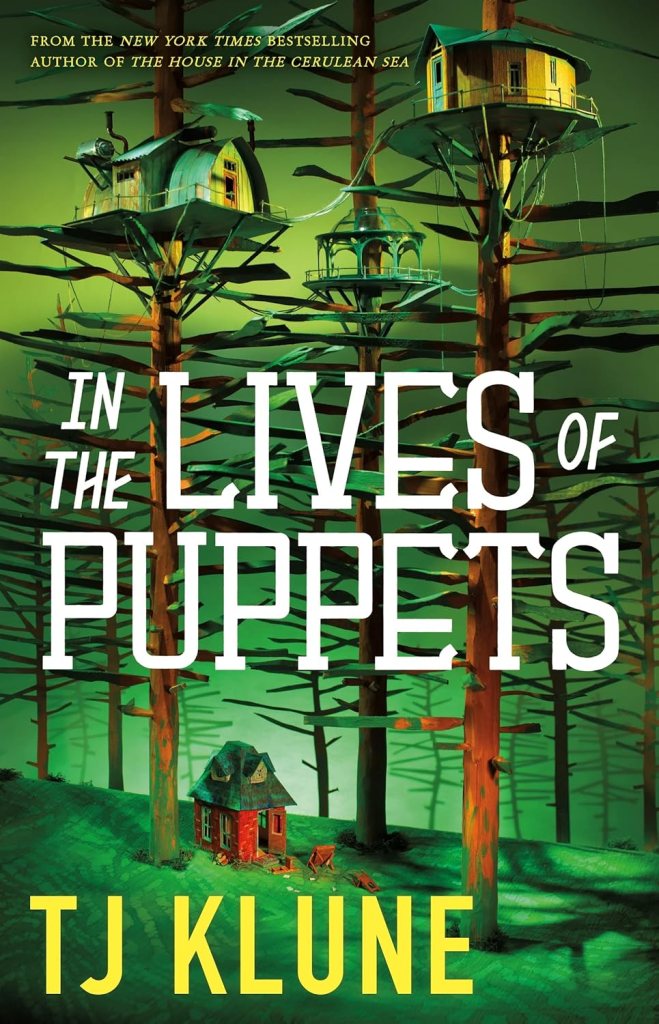
In the Lives of Puppets by T.J. Klune – Fragile & Fierce
Genre: Sci-Fi
Pages: 432
Rating: ★★★★★
Buy: Bookshop.org
This post contains spoilers.
Book Summary
Deep in an enchanted forest, Victor Lawson, a human, lives a quiet life with his robot father Gio and their quirky mechanical companions. But when Victor discovers a broken android with a dark past, it sets off a chain of events that reveals Gio’s hidden history—and puts their peaceful world in peril. As Gio is taken away, Victor sets out on a dangerous quest to rescue him, uncovering long-buried secrets about love, identity, and what it truly means to call someone family. In the Lives of Puppets is a heartfelt, hopeful tale from TJ Klune, blending whimsy and wonder with a powerful emotional core.
My Thoughts
Characters & Dynamic
I did not expect to love this book as much as I did! For a book with primarily robot characters, it made me feel deeply.
Gio trying to right the wrongs from his past through raising Victor, the last human on Earth, was incredibly moving. I was also much more invested in Hap and Victor’s evolving relationship than I expected, especially considering one of them is a reprogrammed android who once hunted and killed humans.
I loved Nurse Ratched’s unhinged behavior, and I thought Rambo’s child-like nature balanced her personality perfectly. Together, the found-family dynamic between them all was one of the most charming aspects of the story.
Literary Influences
There was definitely a Pinocchio vibe throughout the novel, but it was hard to work out which one is the puppet. Hap would be the obvious choice, since they were calling him the “Hysterically Angry Puppet” throughout the book, and because he was being used by the Authority to wipe out humans. But an argument can be made for Gio, who was used to create the HARPs in the first place.
And then there’s Victor, who, though loved by Gio, was kept in the dark and somewhat “used” to make up for his father’s past. By the end, Victor chooses to wipe out the robots’ memories in order to save his father, effectively doing to them what they once did to humanity: erasing identity to preserve life. It’s a moral tangle that asks who the real puppet is.
There were also some Wizard of Oz vibes, which the short story at the back even briefly mentions. Victor is clearly Dorothy. Rambo would be the cowardly lion since he’s constantly anxious and unsure. Nurse Ratched makes sense as the tinman, appearing heartless at the surface. And Hap, with his memory issues and hidden past, feels like the Scarecrow, trying to make sense of a world he doesn’t fully understand.
These layered archetypes added a fairy-tale dimension that enriched the sci-fi elements.
Butterflies as a Motif
One of the most beautiful and recurring symbols in the novel is the butterfly. It symbolizes transformation and growth, which parallels Victor’s emotional and psychological journey. Just as a caterpillar becomes something entirely new, Victor grows from a sheltered, curious tinkerer into someone who confronts fear, loss, love, and identity.
Butterflies are delicate and often symbolize hope in the face of adversity. One striking scene involves Hap stopping mid-conflict, transfixed by a butterfly and afraid of hurting it. That fragility reflects the vulnerability of love and trust, especially in a world that’s often harsh or mechanical.
“Sometimes it’s the smallest things that can change everything when you least expect it.”
In the Lives of Puppets
A butterfly can also represent freedom: elusive, hard to pin down. For Victor and the others—especially Hap—it may symbolize the possibility of freedom, from programming, from past trauma, or from societal systems that seek to control or erase individuality.
There’s a beautiful contrast between the natural beauty of the butterfly and the metal-and-wires world most of the characters inhabit. The butterfly becomes a symbol of life and soul in a place where machines question their morality and purpose. Each appearance of a butterfly feels like a gentle reminder of the characters’ inner transformations, the fragility of their found family, and the enduring hope that they can become more than what the world has programmed them to be. It’s one of the ways Klune weaves magic and meaning into a story about love, identity, and resilience.
Small Details that Stuck With Me
Something I don’t think many people noticed: Victor always refers to himself as Vic in the narration, but everyone else calls him Victor, until the end, when Hap finally calls him Vic. It makes that moment even more beautiful, because it shows that Hap sees him as he sees himself.
There was also one small detail I couldn’t stop thinking about: how did an embryo survive for centuries so that Gio could make Victor from a test tube? I assume it was frozen, but surely there’s a limit to how long eggs can stay viable. Not a huge plot issue, but my mind snagged on it.
Bonus Content: Short Story & Extras
The Rambo care manual included in the ebook version was a fun touch! It might’ve gone on a little too long, but it added flavor to the character’s voice.
There’s also a short story at the end titled Reduce! Reuse! Recycle!, which is about a robot who gets one week of freedom after working ten years before being recycled. It’s a haunting concept. The robot makes a human friend—much like Hap does with Victor—and begins to question the system, asking why it can’t have more time to experience the world.
“Everyone deserves a chance to find out what they could be when they don’t serve others.”
Reduce! Reuse! Recycle!
That short story echoes the book’s themes of love, agency, and the injustice of preprogrammed fate.
Final Thoughts
In the Lives of Puppets surprised me in the best way. It’s whimsical and weird, but also deeply emotional and morally complex. Klune blends fairy-tale inspiration with sci-fi worldbuilding to explore what makes someone human—or more than human.
The characters are memorable, the relationships layered, and the symbolism (especially those butterflies!) lingers long after the final page. Whether you’re here for the found family, the philosophical questions, or just a good cry over a robot with anxiety, there’s something in this book for you.
It’s a story about love, forgiveness, and becoming who you choose to be—not who the world programs you to be. And sometimes, that’s exactly the story we need.
If you’re interested in checking out ‘In the Lives of Puppets’ by T.J. Klune, consider purchasing it through Bookshop.org. Supporting this link helps sustain independent bookstores and keeps this blog thriving.
Other Sci-Fi Book Reviews:
The Ministry of Time by Kaliane Bradley
Dare to Know by James Kennedy
Reincarnation Blues by Michael Poore
Mickey7 by Edward Ashton
This is How You Lose the Time War by Amal El-Mohtar and Max Gladstone
Love what you’re reading here? Support the blog and fuel my next cozy reading session by buying me a coffee.

 Notes from the Shelf
Leave a reply to Book Review: Culpability by Bruce Holsinger – Notes from the Shelf Cancel reply