
This post contains major spoilers. This post also contains affiliate links. If you buy through Bookshop.org, I may earn a small commission—at no extra cost to you. Thanks for supporting the blog and indie bookstores!
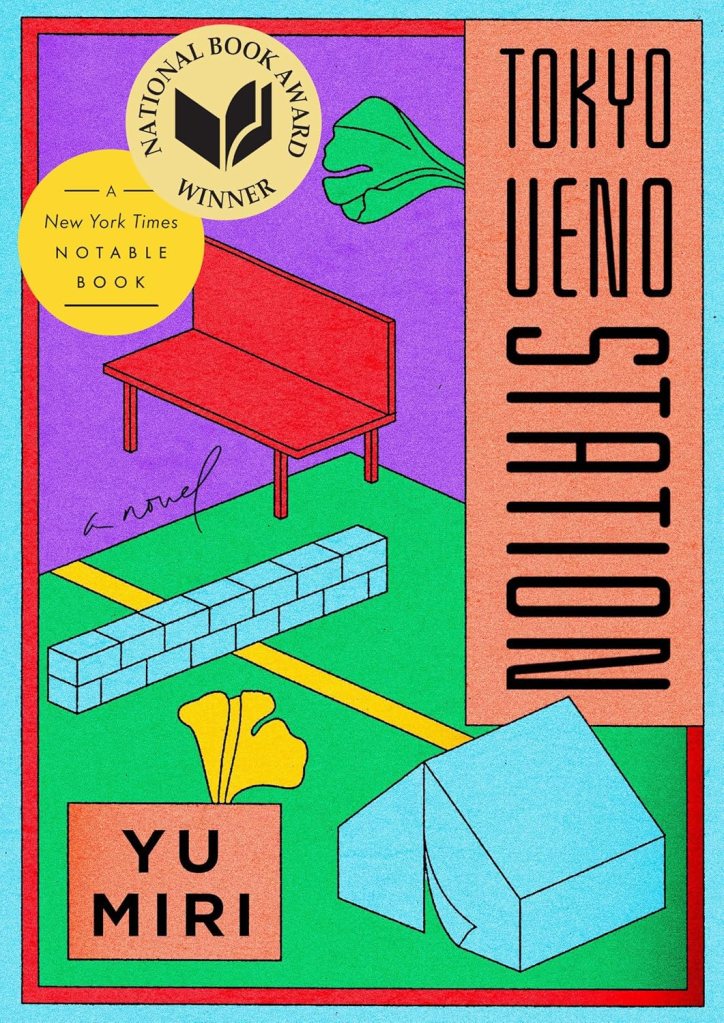
Tokyo Ueno Station by Yu Miri, translated to English by Morgan Giles, is a 168-page contemporary fiction. From the publisher: A surreal, devastating story of a homeless ghost who haunts one of Tokyo’s busiest train stations.
Kazu is dead. Born in Fukushima in 1933, the same year as the Japanese Emperor, his life is tied by a series of coincidences to the Imperial family and has been shaped at every turn by modern Japanese history. But his life story is also marked by bad luck, and now, in death, he is unable to rest, doomed to haunt the park near Ueno Station in Tokyo.
Kazu’s life in the city began and ended in that park; he arrived there to work as a laborer in the preparations for the 1964 Tokyo Olympics and ended his days living in the vast homeless village in the park, traumatized by the destruction of the 2011 tsunami and shattered by the announcement of the 2020 Olympics.
Through Kazu’s eyes, we see daily life in Tokyo buzz around him and learn the intimate details of his personal story, how loss and society’s inequalities and constrictions spiraled towards this ghostly fate, with moments of beauty and grace just out of reach. A powerful masterwork from one of Japan’s most brilliant outsider writers, Tokyo Ueno Station is a book for our times and a look into a marginalized existence in a shiny global megapolis.
Tokyo Ueno Station is not at all what I expected based on the book blurb, and I was pretty disappointed by it. It was really hard to tell throughout the book when he was a ghost and when he was still alive, which is maybe a commentary on the state of society and the homeless population being living ghosts, but I wish it had been clearer in places. Also, the book doesn’t have chapters, it’s just one long string of consciousness, although it does have dinkuses to indicate new parts of the story. I tend to read books by chapter, so I didn’t like that there were no chapters, but that is a personal preference.
There was a lot of back and forth between being homeless, his life before being homeless, and him being a ghost. I did enjoy reading some of his hardships like having to leave his village as a child to find work and never being able to be at home with his wife and kids because he was traveling everywhere to find any kind of job. That was nice to have background on him as a character and to gain a perspective of how it was living in that time. However, there weren’t really any reflections on the big historical events that I thought there would be based on the blurb on the back on the book.
I thought there would be more reaction from him to the 2011 tsunami and Japan hosting the Olympics again in Tokyo in 2020, and maybe even a reaction to the pandemic and more of a history of the first Tokyo Olympics. I felt there was barely any reaction at all to any of those things. The 2020 Olympics was barely mentioned; I wouldn’t even consider it included in the book. I would definitely not say he is shattered by the news, because that is nowhere in there. Also, there’s no mention of covid and barely any coverage on the tsunami.
I assumed he would have a lot to say or reflect on with the tsunami since Fukushima was where he grew up, and the 2011 tsunami caused a meltdown in Fukushima. I don’t feel any emotion coming from him when he hears about the nuclear reactor aftermath in a radio broadcast. Also, at the end where his granddaughter is swept away from the tsunami and he watches her die as a ghost, there is some reaction there, but not enough for me.
This book was definitely heartbreaking, but also disappointing. I think it could’ve been longer to show more emotion and reflect more on the events. There is a whole section on him following two older women in the art museum, reflecting on roses painted from Redoute, but there couldn’t be more reflection on any of the events listed in the blurb?
I give Tokyo Ueno Station 2 stars.
If you’re interested in buying the book, consider buying through Bookshop.org. Bookshop.org helps indie bookstores thrive, and your purchase also supports my blog—so I can keep reading, reviewing, and recommending great books.
Love what you’re reading here? Support the blog and fuel my next cozy reading session by buying me a coffee.
 Notes from the Shelf
Leave a reply to 2024 Reading Challenge Round-Up – Notes from the Shelf Cancel reply