
This post contains affiliate links to Bookshop.org. If you make a purchase through these links, I may earn a small commission—at no extra cost to you. Your support helps sustain independent bookstores and keeps this blog going.
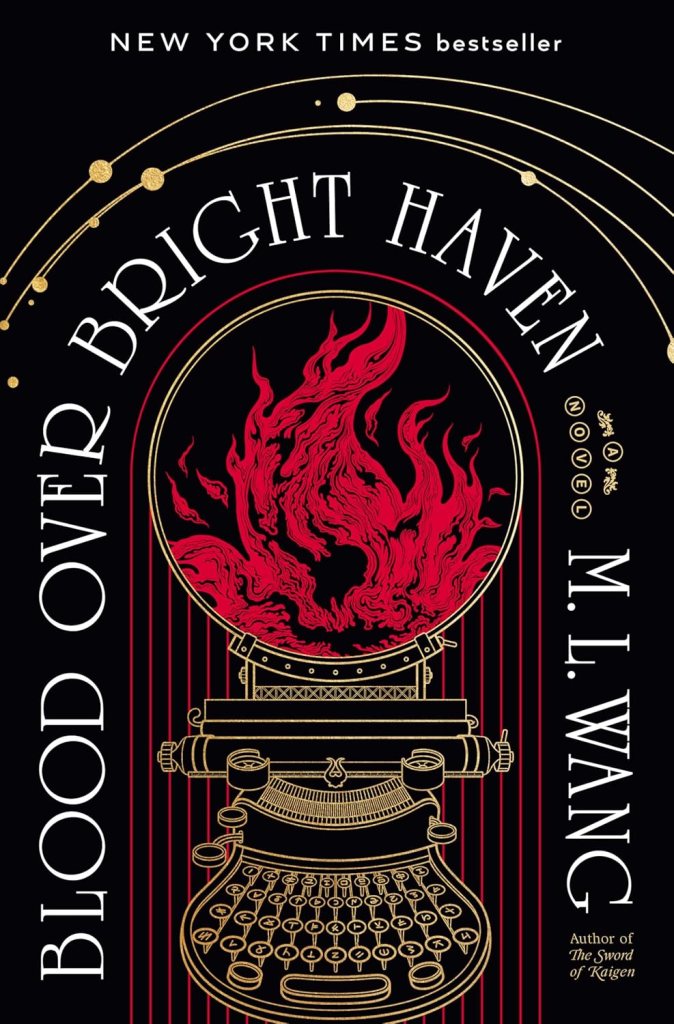
Blood Over Bright Haven by M. L. Wang
Genre: Fantasy
Pages: 430
Rating: ★★★★★
Buy: bookshop.org
This post contains spoilers.
Book Blurb
For twenty years, Sciona has devoted every waking moment to the study of magic, fueled by a mad desire to achieve the impossible: to be the first woman ever admitted to the High Magistry at the University of Magics and Industry.
When Sciona finally passes the qualifying exam and becomes a highmage, she finds her challenges have just begun. Her new colleagues are determined to make her feel unwelcome—and, instead of a qualified lab assistant, they give her a janitor.
What neither Sciona nor her peers realize is that her taciturn assistant was not always a janitor. Ten years ago, he was a nomadic hunter who lost his family on their perilous journey from the wild plains to the city. But now he sees the opportunity to understand the forces that decimated his tribe, drove him from his homeland, and keep the privileged in power.
At first, mage and outsider have a fractious relationship. But working together, they uncover an ancient secret that could change the course of magic forever—if it doesn’t get them killed first.
My Thoughts
Blood Over Bright Haven by M. L. Wang reads as a powerful commentary on the idea that some systems are so rotten at their core that they cannot be reformed, only destroyed. At its heart, this is a story about realizing that incremental change from within an oppressive structure is often impossible, especially when that structure is built on violence and exploitation so deeply normalized that most people never question it. Watching Sciona come to that realization, and ultimately act on it, was both devastating and strangely affirming.
Sciona’s death absolutely tore me apart, but it also felt tragically inevitable. Once she uncovered the truth behind the magic that powered Bright Haven, it became clear that she was not capable of turning away or pretending ignorance. What made her arc feel noble was not that she was perfect, but that she refused to accept comfort or status built on suffering once she understood the cost. She could have stayed silent. She could have rationalized it. Instead, she chose destruction over complicity, even knowing it would cost her everything. That choice is what makes her story linger.
I was genuinely surprised by how dark this novel turned out to be. I went in expecting something heavy, but not quite this bleak. Like many readers, I held onto hope that Sciona and Thomil might find some measure of happiness together, or at least survive side by side. That hope made the ending hurt more, because this is very much not a happy-ending book. It is a book about sacrifice, loss, and the violence required to dismantle entrenched power.
One of the most frustrating aspects of Sciona’s character was also one of the most realistic. Even when she was genuinely trying to do the right thing, she consistently failed to listen to Thomil. Time and again, when he warned her that certain actions would have catastrophic consequences for the Kwen, she dismissed his concerns. Each time, he was proven right. This dynamic highlights one of the book’s strongest themes: good intentions do not erase harm, especially when those intentions come from someone who still benefits from the system in question.
The novel does an excellent job exploring layered oppression. Sciona is undeniably oppressed in Bright Haven’s male-dominated magical hierarchy, yet she is still a High Mage, still part of the ruling ethnicity, and still insulated from the worst consequences of the system. Her prejudice against the Kwen is often unconscious, ingrained so deeply that she does not even recognize it as prejudice. She rarely thinks to ask Thomil how his people might react, and when she does hear his perspective, she often chooses not to believe it. The book makes a sharp point here: being marginalized in one way does not make someone less complicit in the oppression of others.
That said, Sciona’s recognition that she cannot meaningfully change Bright Haven from the inside is one of the most compelling parts of her arc. Even after achieving the impossible and becoming a High Mage, she is still undermined, dismissed, and constrained because she is a woman. The system allows her proximity to power, but never true authority. Her decision to burn it all down feels less like revenge and more like clarity. Reform is not enough when the foundation itself is immoral.
The unraveling at the end of the novel was deeply satisfying in a grim, hollow way. There is something almost poetic about the fact that so much destruction was caused by such a small group: Sciona, Thomil, and his niece Carra. It underscores how fragile these supposedly eternal systems really are once someone dares to challenge their legitimacy. The deaths of the ruling mages, especially Cleon Renthorn, felt necessary. His survival would have been far more horrifying than his death, as he embodied the cruelty and entitlement that allowed Bright Haven to exist as it did.
The survival of the other mage, Jerrin Mordra, however, leaves room for cautious hope. He seemed more open-minded and far less powerful, which matters. Even if he wanted to recreate the old system, the destruction of the central government and magical infrastructure would make that process slow and difficult. For once, the city might actually have the space to change.
I also found the open-ended conclusion incredibly effective. Thomil and Carra fleeing with the rest of the Kwen into the wider world raises so many questions. Will magic return, and if it does, will it once again be fueled by human suffering? Is Bright Haven truly unique, or is it simply the only city we have seen so far? That brief glimpse of the girl by the ocean, whom Sciona accidentally blighted, suggests a much larger world where magic may not exist at all, or exists in a completely different form. The fact that the people there had never seen blight implies that Bright Haven’s practices are not universal, which makes its atrocities even more damning.
Ultimately, this book handles its themes with remarkable nuance. It shows how different minorities experience oppression in fundamentally different ways, and how proximity to power can blur moral clarity. Being oppressed in one axis does not negate the privileges granted by another, and Blood Over Bright Haven never lets its characters or its readers forget that.
Final Thoughts
Blood Over Bright Haven is a brutal, thought-provoking fantasy that refuses to offer easy answers or comforting resolutions. It is a story about complicity, systemic violence, and the painful realization that some worlds cannot be saved without being destroyed first. While the ending is heartbreaking, it is also deeply earned. M. L. Wang delivers a novel that challenges the reader to sit with discomfort, question power structures, and reflect on who truly pays the cost of progress. This is not a book that leaves you satisfied in a traditional sense, but it is one that stays with you.
If you’re interested in checking out ‘Blood Over Bright Haven’ by M. L. Wang, consider purchasing it through Bookshop.org. Supporting this link helps sustain independent bookstores and keeps this blog thriving.
Check out other fantasy reviews:
Katabasis by R. F. Kuang
Our Infinite Fates by Laura Steven
A Language of Dragons by S. F. Williamson
Love what you’re reading here? Support the blog and fuel my next cozy reading session by buying me a coffee.
 Notes from the Shelf
Leave a comment