
Today’s Featured Authors: S&E Black
I first met S&E Black by chance at a local craft event. They were the only authors there, and I was immediately drawn to their story, as well as their beautifully bound book. We decided to meet up mid-June after the Grayslake Author Fest at a local café to have an in-depth, in-person interview. What follows is a lightly edited transcript of our conversation, revised for clarity and readability.
Note: S&E Black currently have a Kickstarter campaign running for Reflections, book two for their series The Chimera Snare. If you’re intrigued by their work, be sure to check it out here.
Meet S&E Black
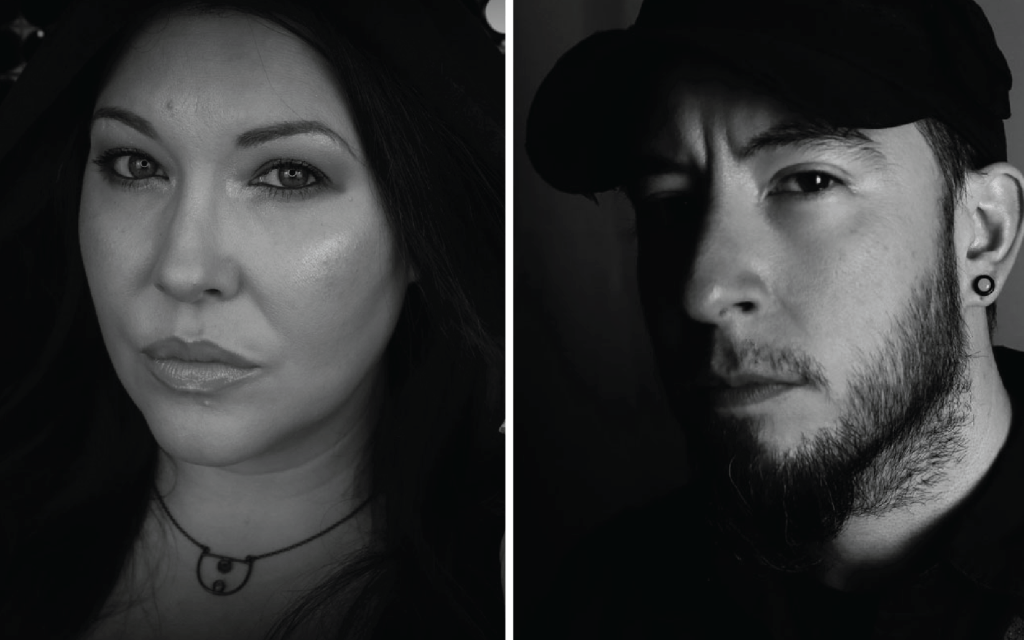
Shannon was born and raised in California and currently lives in Illinois with her husband and their cat rescues. She is an urban gardener and an avid seed collector. In the makeup community, Shannon goes by zoomzoommacaron where she collaborates with fellow MUAS across the world. She hosts a monthly zombie-themed makeup group called the #zombabescollab and adores SFX and other creative makeup. Shannon is also the owner of ShopCorpsicle which specializes in handmade props, fake food, miniatures, prosthetics and other accessories. She uses the alias Silence In Shadows for her traditional art. She also enjoys anime, cult-classic horror movies, cooking (and eating), sunbathing, photography, craft beer, and singing badly.
Music fuels Shannon’s many passions, especially while writing and creating art. She credits music for having a hand in saving her life on multiple accounts in her teenage and young adult years.
Born and raised in the San Francisco Bay Area, Edward first discovered the joys of creative writing through his early high school studies, and has spent many years exploring and developing a deep appreciation for the arts. Since first collaborating with his wife Shannon, he has sprouted a passion and true affinity for storytelling and crafting literature. In addition to refining his skill in creating written works, his other interests include playing bass guitar, listening to music, and dabbling in photography. Edward is currently based in the greater Chicago area with his wife, amidst his ever-growing vinyl collection and clowder of rescue cats.
Q&A
What inspired each of you to start writing in general?
E: Taking writing seriously started with my wife. She invited me into this project. With her first version of Fragments, she published it back in 2015. That was actually around the time we got together, and then she started writing book two. She started bouncing ideas off me. I gave my considerations, like “think about doing this” or “what about this?” and so that just kind of snowballed into the collaboration. She asked me if I wanted to write it with her and I said sure, so that’s when I started taking writing very seriously. Prior to that, I enjoyed writing but very different kinds of writing, like papers, essays, and reflection. I did a couple interviews as well, like summarizing things, so it was very different from writing a novel. Yeah, that’s essentially the long answer of who inspired me to do it is this lovely lady sitting next to me.
S: For me, I started doing short stories with drawings when I was like 6 or 8. I would do it for fun because I had a pretty wild imagination growing up. I had these ideas for the four main characters since high school, and I was like, “I really want to do something with them.” It wasn’t until after high school, I just went right into working and then one sleep-deprived morning going into San Franscisco on the train, I had the most amazing daydream for two of the characters, and it was a story that was never told, so I was like, “You know what? I think I could write this.” You know, I used to write when I was younger, so let’s just give it a shot. Then I started taking it seriously just because it was this thread that’s been following me for a while.
Sara: That’s amazing. So this series was more your idea?
S: Yeah, it was, but what we’ve managed to do together, it’s just turned into this universe that is ever expanding. Like I truly feel like this might be something that we do until we die. Maybe not the Chimera Snare, because that series itself will end after around five books, but there are worlds we don’t really touch, so we’ll probably continue to explore to some degree going forward.
E: Yeah, same for me. I want to keep rolling with it for as long as it’s warranted. Like for one thing, it’s rekindled my imagination. I’ve had this urge to develop and get involved in something creative for many, many years. Initially I was a musician, and I’ve practiced in a few different avenues but all of them didn’t really go anywhere. When you’re collaborating with different people, it can be difficult at times.
S: And fortunately, I would say for this project, we share a lot of the same vision, so we rarely butt heads in that regard.
What inspires you to continue writing?
S: It’s just really the world we’ve created together. I had a story that I really wanted to tell with these characters, and I knew I wanted it to be a series. But what really drove that passion forward was having the right partner to do it with. Plus beer and music [laughs].
E: Yeah, the big thing is music. Music inspired many aspects of this series, so we pull from that quite a bit. It essentially keeps us going. I’ll listen to a song I’ve heard a thousand times, but in a certain setting at a certain time, it can spark something new.
Sara: What kind of music do you like listening to?
S: We mostly have the same vibe, like post rock, black metal, dark ambient, dark gloom, that kind of thing.
E: Yeah, different forms of doom, like funeral doom. It’s been a big well of inspiration. Shape of Despair and Evoken are two bands we often listen to.
S: Yeah, actually at the beginning of Fragments, we give credit to the bands that have inspired us as we wrote. But there’s certain bands he’ll gravitate to, and I’ll gravitate a different way. Like I’ll get into more whimsical things, like where it’s a little bit more hopeful. But also, I can’t listen to certain singing. I need the lyrics to blend into the music or it’ll distract me. Or I’ll just listen to ambient with no lyrics.
E: Yeah, dark ambient is pretty nice for editing.
How did you become collaborative partners?
S: At the end of writing the first book. When we had started our relationship, I would get writer’s block and it’s hard to keep things going in your head, so I would bounce ideas off of him. His brain is wonderful; it’s part of the reason I married him.
E: Yeah, I recall when you started book two, and you had Sundays set aside for your writing days. So at that time, it was her at the table and usually me on the couch playing a video game or something like that, just hanging out, so I observed the process. She kind of looked like a crazy person, just because she’s at the table with like five different notebooks, flipping through them all.
S: Oh yeah, because I’m not very consistent with which notebooks I choose, so I only fill out parts of them. Also, there’s several iterations of what we’re trying to do, so there’s like rewrites of a rewrite that I’m flipping through. So, I would bounce ideas off of him, and then I was like, “Do you want to just write this with me, because you’re pretty good at it.” So that’s how the collaboration happened.
E: At first, I was like “I don’t know about this.” But the more I thought about it, it sounded like it could be pretty fun.
S: We collaborate pretty well naturally, too. It’s like having that fundamental thing in your relationship, it just leads to a really good collaborative effort.
E: It definitely brought us a lot closer. We were already close, we’ve known each other since we were kids essentially, but like when we were like this already [holds up two fingers together], collaborating brought us like this [crosses the fingers]. This unique kind of collaboration that we have is something that’s special. It’s enhanced our lives.
When did you know you wanted to publish a book?
S: It was just this feeling I had with these characters. I knew who these characters were fundamentally, and I need to tell their story. Even just putting your work out there, putting your heart on the line for people to experience this, it’s quite terrifying. But I was like, you know what? There’s no other way it’s going to happen. We just have to do this. So, it just boiled down to figuring out how to do it. It’s a lot of work. It’s a lot of learning. In the very beginning when I did things by myself, I had the story and kind of knew what I thought I wanted to do, I but didn’t push it very much. I don’t think it was as good as it could have been [the original version], but what Fragments is now was everything I wished I was able to write on my own. It just wouldn’t be what it is without the both of us.
How did you first get published?
S: First I published with Lulu. It’s more of a distribution center. It’s still self-publishing, they just provide you with the tools. They don’t have an editor, you have to do all that stuff yourself. If you’re an inexperienced author, they’ll help you format your manuscript. They say they’ll market it, but they didn’t do too much. They might even partner with Ingram to get it through distribution on Amazon, I’m not sure. They also say they make it available for bookstores, but maybe also through Ingram? It’s a little weird, like maybe should have just went to Ingram in the first place, but you don’t know any better.
Then when we were working on book two, we were re-evaluating the first one. We really wanted to re-make it for our project together. We had learned a little bit more now with being on the field for a while. You start to hear things from other authors, what their experiences are, to decide if you want to go with big box publishing or not. In a lot of respects, you feed a machine with big box publishing.
That’s what led us to start Clay Urn Publishing. We can keep 100% of the rights, and nobody tells us what to write or when to write or what to put on the covers. Also, no changing anything without our knowledge.
E: Yeah, we operate on our own deadlines, no one else’s. With starting our own publishing company, we’re properly able to give the series the attention it needs and deserves, without being under the gun of any deadlines.
S: Also having the publishing mark, the imprint, you really do need that to get into bookstores and libraries and places like that. But we do have to do the editing, formatting, marketing, all that stuff ourselves now. But as this project has been going on for so long, we’ve matured as writers and have a really firm direction with where we’re going. But it’s still just a lot.
E: But it’s worth it. It became an asset, and we can help other people now, too.
S: Exactly. Because there’s a lot of gatekeeping in certain industries, and we don’t want to do that, you know? Any help we can give other people, I think it’s great.
What is your writing routine, either individually or together, or both?
S: Before we get started, we have to know the start and finish. That’s always key for us. We have to hammer out the framework first. The routine lately has gotten a little crazy with all the events we’re doing, but before, we would set aside Sundays to write and work together. We each have the parts we’re working on, and then we’ll comb through each other’s work and hammer out the final manuscript together.
E: The routine definitely looks different now than before we released Fragments. Before it came out, we had a more solid, rigid routine where we would only write on certain days, because we have day jobs and other hobbies. It was easier to incorporate writing Fragments, but now it’s just every spare minute essentially goes to the project since we’re promoting Fragments at events while also writing and editing Reflections [book two].
S: And he’ll have moments where he’ll be going to bed but then he’ll have a thought and won’t be able to sleep until he gets it out.
E: Yeah, I don’t know what prompts it, but when it’s time to go to sleep I have these great ideas. It keeps me up, so then I just have to get up, go over to my computer, and write it out. At least the general idea. So then I can sleep.
How do you develop an idea from initial spark to finished manuscript?
S: So for us, we’re pretty dedicated with this particular series right now, so we at least have the main arc already, like the start and finish. So everything has to fit in between those lines. We’ll have that spark and have ideas, and maybe they’ll make it into the manuscript or maybe not yet and we’ll have to further develop the idea. But it’s all these moving parts; we have to stay super organized.
E: Yeah, once the spark hits, it all comes down to getting the idea out of your head, however that’s done.
S: And it’s fitting that idea, like is that idea going to work? Where exactly are we going to use it?
E: Yeah, ultimately deciding if it’ll make sense or not, like if it’ll enhance the story. Often, when we get these sparks, and we start throwing the idea back and forth, it usually turns into something really solid. Other times, it might not work.
S: We also take a lot of notes. You keep everything, and it might actually fit somewhere eventually.
E: Also, when we have a vision in our heads for how this idea will play out, we do that in our own styles. For me, I begin with dialogue because I hear the talking in my head, like how certain conversations are going to go, so I map that out loosely at first. That’s how I set the scene, and then I’ll fill in with the descriptions later.
S: And I’m not that way. I am very granular with how I start. I have to be in the scene, seeing what’s going on in front of me. I have to see what’s around me first [for the scene]. It’s more of a cinematic approach. If I don’t get a clear vision of that, then I can’t write it. Once all those ideas are out there, then we have to shave away at the stuff that doesn’t make sense, make it less of a movie and more like a book.
Sara: That sounds like it works really well for both of you, since E is the dialogue and S is more the scene descriptions.
S: Yeah, we complement each other with that. We just keep tossing a scene back and forth and then it becomes a nice, beautiful piece.
Have you dealt with writer’s block and how do you handle it?
S: Beer, music and running. I know those don’t always go together, but for me, when I run and listen to music, it’s like a cinematic thing that happens. It helps me see the scenes. It might be in a way that’s not really expected, and it might not be for that particular part, but sometimes when you get jolted with that creativity, you’re able to immerse yourself back into that again. But beer definitely helps to grease the wheels, to not be so rigid in the direction the story is going. Beer and music is really for the both of us, I think.
E: Yeah, for me, I haven’t had too many blocks thankfully. But music certainly helps. Beyond that, if nothing’s really helping, I just have to step away for a little bit.
S: Yeah, I’ve gotten to that point where it’s like, this is my day to write, I’ve dedicated the entire day, and I’ve written less than a hundred words. It makes me feel bad because I don’t get many days to write and if it’s an unproductive day, it’s disheartening. You can try to force yourself to write, but really you might just have to step away and do something else. The garden is another thing for me because I like to put my hands in dirt. Then I’m just mechanically doing things and my thoughts can wander, and that helps to break out of a block.
E: Yep. I’ll observe somebody walk down the street, just something small like that, and it can give me a new idea. Sometimes I was just experiencing this block because the idea was just not good. So then developing it further isn’t warranted.
S: Yeah, you just have to let it go sometimes. Maybe keep it as a note, but let it go. Have you seen the movie Secret Window with Johnny Depp? It’s a really good movie where he’s a writer. He’ll be in front of his laptop, hair a mess with his robe on, and he’s reading over what he’s written, and then he is basically like “Oh wow, this is crap.” So he highlights it and he’s like, “Just do it, just delete it all. No bad writing.” And then he just hits delete. It’s so true. You don’t want to do something that’s ultimately not going to fit and just screw your story up.
E: Exactly. Just let it go. No bad writing.
What’s the best writing advice you’ve ever received?
S: I sadly wasn’t met with much good advice when I was doing this project myself. It wasn’t really until we started working together that I started getting more positive reassurance.
E: I think for me, when I talked to people about the project, I was really eager to get it out there, but they often would say, “Take your time.” It kind of loosened my own expectations, because it’s okay to take our time with this.
Beyond that advice, it’s really just the trust I was given with this project because it did start with her inviting me in. She invited me into this openly, and it’s something that’s a part of our life for many, many years, so it takes trust to do that. I try to earn that trust by treating this project with respect and just do what I can to make it the best it can be.
Do you have any advice for aspiring authors?
S: At the core of it all is to decide why you’re writing in the first place. Make your decision on how you want to get it out there. If this is something you’re really passionate about, like you’re writing about a story that’s tethered to your core, like true art is, you owe it to yourself to make sure you’re protecting your work when you put it out there.
If you’re looking to get published, there will be documents you have to sign, and make sure you really read those documents. And if you don’t understand them, hire someone to explain it. You don’t want to be blindsided when all of a sudden, the rights to your project aren’t yours anymore. It’s really just figuring out what you want and make sure whatever method you use matches you.
Also, tell your story the way you want it told if it’s a passion project. People do things for different reasons, but if you’re really passionate about it, tell the story the way you want to tell it. Don’t write for an audience because your audience comes.
E: Yeah, that’s a big part of it. Granted, there are plenty of authors out there that will write for an audience because they know where the money is, right? That’s what they’re focusing on. If you’re writing for a living, your initiative for writing is different. Writing for a living comes with the understanding that you have to produce an income that will sustain you.
Otherwise, for an aspiring author just starting out, the important thing from my perspective is write from the heart and write what you want to write with intent and honesty. In my opinion, as long as you do that, that’s the best way that you will find your unique voice and unique style.
S: Also, don’t use AI. Get a real person for your covers. Canva isn’t good for covers either. Work with a proper illustrator to give you that identity, your brand, which is what we did with Adrian Baxter. Use some of your resources to have someone give you a proper identity. You can’t always do everything yourself. I really wanted to do the cover myself, but it would not have turned out as good as it did.
E: Yeah, part of it comes down to building your brand. Every author essentially has to brand themselves if they want to stand out.
S: Yeah, just no AI please. We had someone come up to us at a book event and he said he was a generator. He said he wanted to generate a book so he could get into these book events. I’m like, you just said that to two authors, like you just slapped us in the face essentially.
E: Yeah, quite frankly it’s heartbreaking to see. It’s ethically wrong and it is theft. I saw a post on Facebook that basically this guy said, “Why would anybody read something that nobody bothered to write?” I thought that just summed it up so succinctly and beautifully because like yeah, why would you read something like that?
Which books or authors have most influenced your writing?
E: One author I really love is Gillian Flynn. She writes thrillers that are really exciting to read. She has a great way of unfolding the mystery and throwing twists in there.
S: I didn’t like reading growing up besides like comics and manga, so Dragonball Z was like my lifeblood. Also, Angel Sanctuary, things like that. I think that helped my brain stay in these mystical, otherworldly places [for my writing].
A lot of books I read growing up were forced for school, and I was like, “A book with nothing but text? This is awful.” Which is funny now that I’ve written one of those.
It’s also changed now because we’ve been connecting with a lot of different local authors. Blood Circus was so good. I stayed up until like 3:00 in the morning several nights reading it. I couldn’t put it down. The process I’ve gone through to write has turned into more of a passion to read as well.
E: I’ve also enjoyed many video games, and when I’ve had writer’s block and had to step away, I would jump into playing Assassin’s Creed. Those games are really well put together, writing wise, so whenever I would play those, they influenced how I would frame certain dialogue.
What book(s) are you currently reading?
E: I’m currently reading Atomic Love by Jesse Rose. She’s actually a friend of ours. I started it a while back but then we got caught up in editing mode for Reflections, so I haven’t been able to go back to it yet.
S: Since we’ve been in editing mode, I actually re-read Fragments just to keep my head in the game. We’ve just been editing and sleeping. Once editing is done and it’s with the beta readers, I’ll get back into reading.
What’s something readers might be surprised to learn about you?
E: We have ten cats.
S: They’re all rescues, too. Also, I do zombie makeup with a group of makeup artists from the UK and Canada. And I have over 200 wigs and 500 contact lenses to go with my makeup hobby.
E: I also have over 800 vinyl records in my collection.
Wrapping Up
A huge thank you to S&E Black for taking the time to hang out and chat with me at the café, especially after a long, hot day at their booth. I came away from this conversation inspired and filled with insight on publishing, collaboration, and what it really takes to bring a novel to life. One day, I hope to use these lessons on my own publishing journey!
Also, I have to say—their book covers are absolutely stunning, and the hardback special edition is top-tier quality. I’m obsessed with the swag they’ve put together, and I love their commitment to supporting local bookstores, women-owned businesses, and the indie community. Their values really resonate with my own, and it was a joy getting to know them better.
Where to find The Chimera Snare book 1: Fragments
S & E Black have built relationships with indie bookstores because they know the importance of supporting local and indie stores. Their website The Chimera Snare lists the local stores where Fragments is shelved. It can also be ordered through their independent publishing company, Clay Urn Publishing, which also has a shop with curated bookish items that have been developed with independent, women-owned businesses.
The book is also available through Bookshop.org. When you buy through this link, you’re supporting independent bookstores as well as this blog. I may earn a small commission at no extra cost to you.
What’s their next book?
The Chimera Snare book 2: Reflections is coming Spring/Summer 2026.
This haunting prequel to Fragments plunges into the past, where fates intertwine and vengeance and destiny collide.
To bring this next chapter to life, S&E Black are running a Kickstarter campaign starting July 19th and running for 60 days. Backers will have their names printed in the book as a token of gratitude.
Be part of the story. Help make book 2 a reality!
Connect with S & E Black
You can find S&E Black @thechimerasnare on Facebook, Instagram, as well as their blog, where you can check out upcoming bookish events they’ll be attending as well as some behind-the-scenes information.
More Conversations with Authors:
Zee Lacson
Lina Chern
Love what you’re reading here? Support the blog and fuel my next cozy reading session by buying me a coffee.
 Notes from the Shelf
Leave a comment