
This post contains affiliate links to Bookshop.org. If you make a purchase through these links, I may earn a small commission—at no extra cost to you. Your support helps sustain independent bookstores and keeps this blog going.
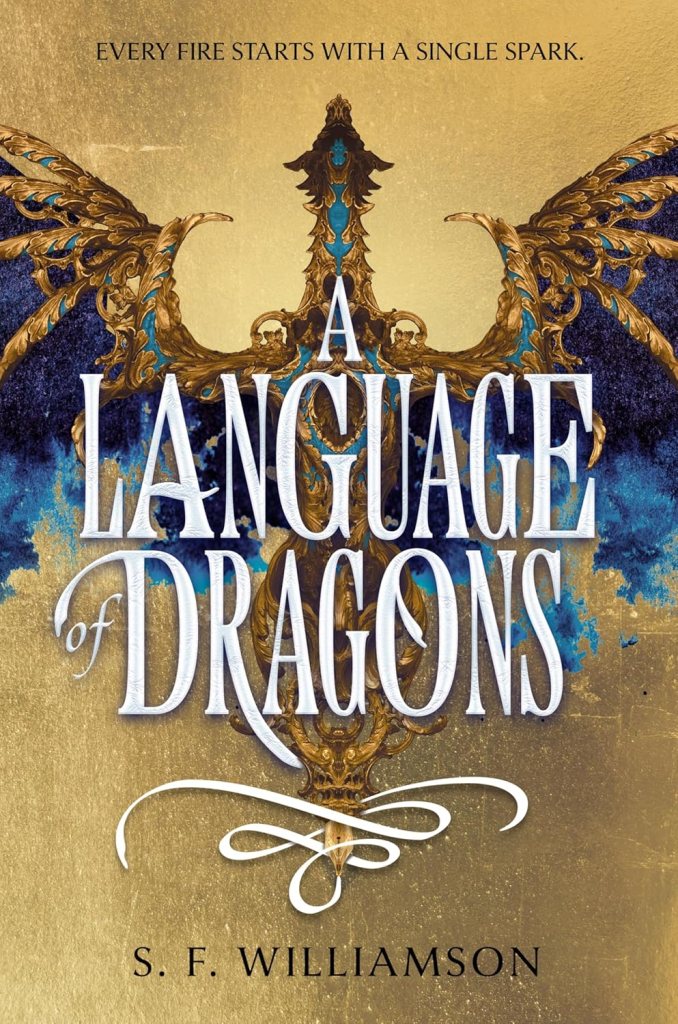
A Language of Dragons by S.F. Williamson – Secrets & Rebellion
Genre: YA Fantasy
Pages: 432
Rating: ★★★☆☆
Buy: Bookshop.org
This post contains spoilers.
Book Summary
Vivien Featherswallow has a plan: follow the rules, impress the right people, and earn her family’s spot in society—one carefully spoken word at a time. But when a forbidden act of defiance unleashes a legendary dragon, Vivian is thrust into a dangerous game of power, history, and rebellion. Now her only path forward is through Bletchley Park, where decoding a secret dragon language might mean survival—or total collapse.
But as secrets unravel and loyalties are tested, Vivian begins to question everything she’s been taught. Why are dragons kept separate? What really happened during the last war? Torn between her duty and her conscience, she’ll have to choose: follow orders, or find her own voice in a world built on silence.
My Thoughts
Worldbuilding & Setting
I liked the idea of A Language of Dragons. Who doesn’t like dragons, and it’s set in the early 1920s, which I enjoy reading about from a historical perspective. However, this world is not our own. It’s meant to parallel our world, but with dragons fighting for equal rights, and the great world wars have been against the dragons.
It gives me big The Imitation Game vibes. If you haven’t seen the movie, I highly recommend it. The movie is about codebreaking and is set at Bletchley, just like with this book.
It was irritating that they kept calling the dragon code telepathy. It’s echolocation, which is not telepathic. Just because humans can’t hear it doesn’t mean they dragons are reading each other’s minds. It was mentioned multiple times, which I found really annoying every time.
Vivian as a Character
I found Vivian to be insufferable for most of the book. She’s self-centered to her core. Even at the beginning, she talks for the group when they’re first given their assignments. She also doesn’t work well with the codebreaking team because even from the beginning, she wants to be the one person known for breaking the code. It’s partly to make sure her family is saved, but she also has her pride and would like to be the one known to history.
She makes questionable choices throughout most of the book. She releases Chumana, the library dragon, to set fire to the administrative building just to destroy the evidence against her parents, without any thought that she just committed terrorism and arson, and no thought on what workers are inside either.
She thinks she’s very clever, but she just came across as so dumb to me. Even when the groups became a competition, where only one person per team would be pardoned, she was surprised when people tried to kill her. I could see the first one being a surprise to her, but after that I would be more on guard, but she continues to think she’s perfectly safe.
I think a lot of it is to do with she’s in denial. First, she is in denial that her parents could possibly be rebels. Then she’s in denial that the Third Class is that bad, like dire. She’s shocked to find they literally have nothing, but she was always so scared of ending up Third Class if she failed, so she knew on some level how bad it was. She just didn’t care until it started to impact people she knew and cared about.
Then she’s in denial that the prime minister would possibly lie or not be who she presents herself to be. The list goes on and on. There’s so many opportunities for Viv to change her mind from what she experiences and the stories she hears from the other workers, even her cousin and the boy she falls in love with, plus the things she learns about the dragons, but she doesn’t allow herself to believe any of it until almost the end of the book. Even Chumana tells her she’s on the wrong side of history, and she wouldn’t believe it! Every piece of evidence she’s given, she doesn’t care or she makes excuses.
It finally clicks for her after about 80% of the book that “just following orders” isn’t a good enough excuse after finding out Chumana had helped kill people in Bulgaria. Viv’s mom is from Bulgaria and narrowly escaped as a child, so finally it clicks for her but only when it directly impacted her! This was so frustrating.
Maybe the book is trying to show how people end up on the wrong side of history not from malice, but from desperation or due to personal motivations. But to make that work, the protagonist has to be a sympathetic character—and Viv’s just not.
Comparison to Other Books
The first book I thought of when I read the blurb for A Language of Dragons was Babel by R.F. Kuang. After reading it, I get the vibe that it’s definitely trying to be Babel, but it falls short, both on the language side and the rebellion side. I really enjoyed the linguistics and translation in Babel, and thought it would be similar for A Language of Dragons, but it didn’t go into the language side enough for me, and the rebel side also fell short with Vivian not getting with the program until basically the end of the book. A Language of Dragons is a duology, so now that she is with the rebellion, maybe I’ll enjoy the second book better.
It also gave me When Women were Dragons by Kelly Barnhill vibes, which I also didn’t enjoy that book very much, but in hindsight compared to A Language of Dragons, I think maybe it was a bit better. They both have dragons and are set in historical times, and both were a bit heavy-handed with their messaging.
Lastly, especially toward the end, I thought of Divine Rivals by Rebecca Ross. Again, they both have magical realism in a historical time period, with a war going on and lovers on opposite sides, but Divine Rivals was infinitely better in my opinion. I recommend the audiobook because it has dual narration, and it’s amazing, very immersive. I usually cannot listen to audiobooks, but Divine Rivals kept my attention.
Final Thoughts
This is very much a YA story about learning from your mistakes and waking up to the bigger picture. While I struggled with Vivian’s choices and the pacing of her growth, I think the book is trying to explore how good intentions can be dangerously misguided. If you like your fantasy with morally gray themes, political tension, and dragons that don’t always breathe fire—but definitely have bite—this one might be worth checking out, especially with a sequel on the way.
If you want to buy A Language of Dragons, consider purchasing it through Bookshop.org. Supporting this link helps sustain independent bookstores and keeps this blog thriving.
Read Other Reviews:
When Women were Dragons
Divine Rivals
Love what you’re reading here? Support the blog and fuel my next cozy reading session by buying me a coffee.
 Notes from the Shelf
Leave a comment