
Book Summary and Takeaways:
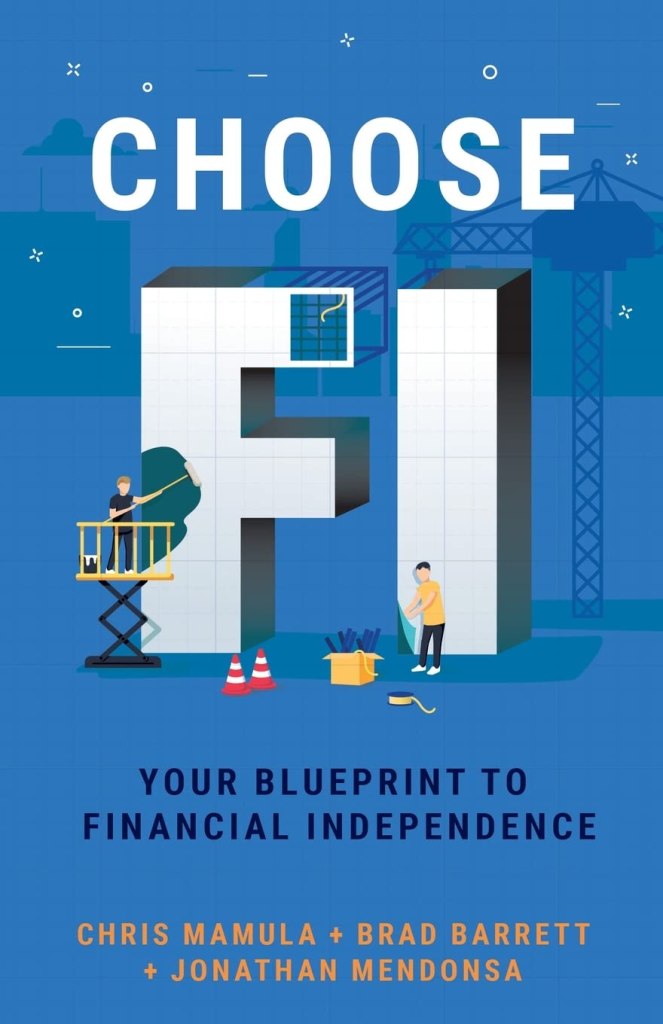
Choose FI: Your Blueprint to Financial Independence
This post contains affiliate links to Bookshop.org. If you make a purchase through these links, I may earn a small commission—at no extra cost to you. Your support helps sustain independent bookstores and keeps this blog going.
Quick Summary
Choose FI: Your Blueprint to Financial Independence is a practical guide to breaking free from the 9-to-5 grind by spending smarter, investing wisely, and designing a life on your own terms. With real-life strategies and actionable steps, it shows how financial independence isn’t just for the ultra-wealthy—it’s achievable for anyone ready to take control.
Book Details
Authors: Chris Mamula, Brad Barrett, and Jonathan Mendonsa
Genre: Personal Finance
Published: 2019
Pages: 325
Rating: ★★★★★
Book Resources: choosefi.com
Buy the Book: bookshop.com
Who Should Read This Book?
Choose FI is perfect for anyone who feels stuck in the paycheck-to-paycheck cycle, wants to escape the traditional retirement timeline, or is simply looking to gain more freedom and flexibility in life. Whether you’re new to personal finance or already on the path to early retirement, this book offers clear, actionable advice to help you optimize your spending, increase your savings rate, and build a life centered around your values—not your job.
Key Takeaways
- Start with your “why” and build your FI plan around it. Knowing why you want financial independence helps you clarify your values, set meaningful goals, and determine how much you need to save based on your desired lifestyle.
- FI is a series of milestones, not a single leap. From paying off debt to reaching zero net worth, building an emergency fund, hitting six figures in investments, and ultimately reaching full FI (25x annual spending), every stage builds on the last.
- Your savings rate has the biggest impact on your FI timeline. A higher savings rate drastically shortens the time to FI, and even small increases (like going from 5% to 10%) can cut decades off your path.
- Focus on the three levers of FI: spend less, earn more, and invest better. Optimize your lifestyle and career intentionally—cut unnecessary spending, increase income through skill-building and smart job moves, and invest in tax-advantaged and low-cost index funds.
- Keep investing simple and consistent. Instead of chasing individual stock “winners,” prioritize low-cost index funds for long-term growth. This strategy reduces risk, requires less maintenance, and has historically outperformed most active management over time.
Book Breakdown
Choose FI: Your Blueprint to Financial Independence is broken down into four main sections: Getting Started, Spend Less, Earn More, and Invest Better. I’ll break down the main ideas for each section.
Getting Started
This section focuses on creating your own FI story. There are a million ways to get there and everyone’s path looks different. You need to start with your why: why do you want to be financially independent and what does your day-to-day look like when you do achieve financial independence.
Knowing why helps you decide what you truly value and to spend your money accordingly, and it will motivate you to get through those tough days. Having your goals in mind will make it easier to plan how much you truly need to save to reach FI, and it will also inform the types of investments you can make. For example, you would need to save and invest differently if you want to buy a house in 5 years vs if you want to retire in 30 years. It’s imperative to start with what you truly want to accomplish to be your guide through the process.
It’s also important to have a growth mindset. Curiosity and a belief that you can improve goes a long way. Also, small wins add up over time. You don’t have to start huge. Just making small improvements to your spending or making a bit more to save can make a huge impact over time.
The stages of FI are also outlined. First is getting to zero net worth. Most people have negative net worths due to things like car loans, student loans, or mortgages, and what they’ve saved or have in other assets don’t outweigh those debts, so that’s the first step.
Next you’ll want a fully funded emergency fund, which is traditionally three to six months of expenses. You would need to decide how much you really want in case of emergencies. For some people, saving $1,000 is enough of a cushion to not worry about emergencies popping up, but for others they may want six months or more saved. Everyone’s goal will be different, so look at your necessary expenses (things like basic bills, not TV subscriptions or discretionary spending!) and save accordingly.
The next milestone is hitting six figures in your investment portfolio. At this point you’ll start to see your money is making money for you. Maxing out a single 401(k) will get you to this point in a little over five years.
The next milestone is reaching half FI. This is where your assets will be around 12.5 times your annual spending. This is half the amount you need if you’re following the 4% rule of only taking out 4% of your investments to live on. 4% is a good estimate so you don’t run out of money while you’re living FI because the market often will make more than 4% per year.
The next milestone is getting close, where your portfolio reaches 25 times the annual spending for your essential costs like housing, utilities, and health insurance. This means you could quit your job and not worry about your basic living. You’d only need a job to cover any luxuries you’d want, so that would depend on your goals.
The next milestone is fully FI, where your portfolio is 25 times your total annual spending, including all your luxuries. You should also factor in extra things like traveling that you might not be currently doing but want to do more once you’re no longer working. 25 times your annual salary goal is used for the 4% rule, so if you want $3,000 every month to live on, you’d need to save $900,000 to be fully FI.
The last milestone is FI with cushion, and it is optional depending on your goals and risk tolerance. This is where your portfolio reaches 33 times your annual spending, which would allow you to take out only 3% per year. The 3% rate has never failed in any historical setting.
They also focus on the three levers to FI, which is spending less, earning more, and investing better. You can leverage each of these to different degrees depending on your situation and goals.
Spend Less
The first thing they outline for this section is a chart that shows how long it’ll take to become FI based on your savings rate. I think this chart is one of the best pieces of information in the book, as it was very eye-opening to me. The chart ranges from a 5% savings rate equaling 66 years to FI, down to a 95% rate taking less than 2 years. That’s not realistic for most people, but even just bumping up your savings from 5% to 10% knocks off 15 years of time (from 66 years to 51 years).
There is also the concept of Lean FIRE and Fat FIRE, FIRE standing for Financial Independence, Retire Early. Lean FIRE can be extreme, living on $10,000 or less a year or having a savings rate of over 80%. This would allow you to reach FI very quickly because you’d have a high savings rate and also don’t need to save as much if you plan on continuing to live that lean in your retirement. Fat FIRE is basically the opposite, where maybe you don’t want to optimize every aspect of your life or have a tighter budget. You’ll still get to FI if you are consistent, but it will take longer.
They also discuss tax strategies. Maxing out your 401(k) is a good place to start, because that is taken out before income taxes, which can lower your tax burden depending on your tax bracket (for the U.S.). Also, most companies will match up to a certain point, so at least investing the max match is a good idea, as that’s free money. Also, since you don’t see that money in your final paycheck, it doesn’t feel as burdensome to be without it, at least for me.
Another thing is if you’re eligible for a Health Savings Account (HSA). This is also pre-taxed, further lowering your tax burden, and often has an investment option, which can be used for non-medical expenses after you reach a certain age (typically retirement age), so it can act as its own long-term retirement account. Flexible Spending Accounts (FSA) can also be a pre-taxed option, but those have to be spent within that year, so they cannot be used as a long-term investment.
The biggest thing is deciding what you truly value and spend your money on that. If you’re just buying things to keep up with the Joneses, then really evaluate that and decide on better ways to spend that truly give you joy and align with your values. This could also open up some amount that can instead be invested to better align with your goal of reaching FI.
They also talk about traveling, specifically geoarbitrage, which is the idea of earning your income in a high-cost area to max out your salary potential, but spending that money in a low-cost area so each dollar stretches more. This can be done if you can work remotely or are a digital nomad, but also traveling to lower-cost areas for the tourist visa time (typically 1-3 months) when you do reach FI. Planning to spend three months every year in a lower-cost area could allow you to reach FI sooner.
Earn More
They first talk about hacking college, meaning explore the job you want and the type of degree that is needed, and then getting that degree for cheap. This could involve going to a community college for the first year or two to get the electives or foundational courses at a discount, or choosing an in-state school instead of the prestigious school. It’s important to decide if you even need to go to college for the job you want, and if you do need it, then look at your expected salary vs the student loan cost to inform your decision on which schools to apply for.
Another way to “hack college” is to get a job without the college degree and then have the company pay for your degree while you’re working. Then you’re getting job experience, moving up the corporate ladder, and getting the degree for low cost or free. Most companies have some kind of tuition reimbursement program, but be sure to look at the terms. Some require a certain letter grade per course or require you to work there for 3+ years after receiving the degree.
There are also alternatives to college, so it’s important to take a look at those, too, like trade schools or apprenticeships. College isn’t for everyone, and every year it’s more expensive, so it doesn’t always make sense for your financial goals.
Also, look at your career as an investment. Identify a skill that you can learn in a year to increase your value as a worker. A lot of jobs have courses to learn different skills for free, so utilize these to expand your skillset. View each job as a stepping stone to a better role, either within your company or elsewhere, as each role builds upon the one before it. Also, make sure you keep your manager informed regularly of your achievements to keep you top of mind for raises or promotions.
Lastly, build a network. Find a mentor or be a mentor to someone. Join committees or attend events within your industry or within the industry you want to join. You never know when an industry contact will come in handy.
Invest Better
There are three investment paths they outline. The first is the simple path. This involves traditional investments such as stocks and bonds held in low-cost passive index funds. This is a consistent way to achieve FI, but with one caveat: you have to have a higher savings rate than the traditional advice. Traditionally it’s said to save 10-20% of your income, but you would need to do more to reach FI sooner than your typical retirement age. This path is appealing because of it’s simplicity, and it works the best if you have a high income, live frugally, or a combination of the two. If you just go to work and save as much as possible from your paychecks, then eventually you’ll reach FI.
The second path is the active path. This involves investing in your own business. With traditional investments, there’s a limit to how much you can make in a year, but with your own business, there’s technically no limit to how much you could make. However, it can be riskier. It requires a lot of research into your product and the market you want to enter, and even with all of the proper research and precautions taken, it could still not work out.
The third path is the hybrid path, which is real estate. Investing in real estate can produce regular earnings like those of stocks and bonds, and typically the property value will increase, allowing for a more passive increase in your portfolio, but it is also like running your own small business.
They also discuss investing in index funds. Don’t be swayed to pick “winners” in the stock market. It’s very difficult to know which individual stocks will produce the best value over time, unless you dedicate your full-time job to it. Even financial managers don’t typically outperform index fund growth over a longer period of time. It’s less risky to invest in index funds and you’ll have more consistent growth over the long term.
Final Thoughts
Financial independence can feel overwhelming, but Choose FI breaks it down into clear, actionable steps. Whether you’re just starting out or fine-tuning your approach, this book offers a flexible roadmap grounded in real-life experience. One of its most powerful messages is that FI isn’t just for the wealthy or lucky—it’s for anyone willing to be intentional with their time, money, and values. Small changes add up, and consistent progress—not perfection—is what truly moves you forward.
Related Posts:
Top 3 Finance Books
Self-Help Books I Loved and Hated
Love what you’re reading here? Support the blog and fuel my next cozy reading session by buying me a coffee.
 Notes from the Shelf
Leave a comment