
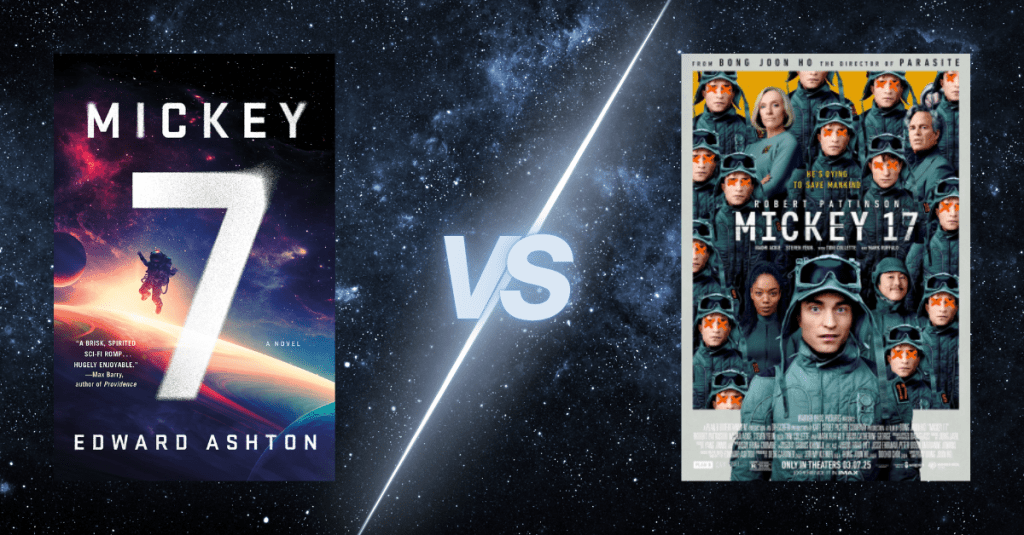
This post contains major spoilers for both the book Mickey7 by Edward Ashton and the movie Mickey17 directed by Bong Joon Ho. This post also contains affiliate links to Bookshop.org. If you make a purchase through these links, I may earn a small commission—at no extra cost to you. Your support helps sustain independent bookstores and keeps this blog going.
Mickey7 vs. Mickey17:
What the Movie Changed & Why It Matters
Quick Overview
| Mickey7 | Mickey17 | |
| Author/Director | Edward Ashton | Bong Joon Ho |
| Release Year | 2022 | 2025 |
| Genre | Sci-fi, Satire | Sci-fi, Thriller, Political Commentary |
| Main Character | Mickey Barnes | Mickey Barnes played by Robert Pattinson |
| Core Premise | Expendable clone on a colonization mission | Same basic premise, radically reimagined |
TL;DR
Edward Ashton’s Mickey7 and Bong Joon Ho’s Mickey17 share the same sci-fi premise—a disposable clone stuck on an ice planet—but that’s about where the similarities end. The book is a fast, satirical take on survival and identity. The movie? A brutal, politically charged reimagining with ethical horror, sharper character arcs, and more emotional stakes. From clone psychology to alien diplomacy, everything is dialed up, flipped, or completely rewritten. Whether you prefer dry humor or dystopian dread, this breakdown covers the biggest differences and why they matter.
A Tale of Two Mickeys
Mickey7 and Mickey17 differ so wildly, they’re basically alternate-universe fanfics of the same premise. Sure, the main idea is the same: Mickey is an Expendable sent on a colonization mission to the ice-planet Niflheim, escaping debt back on his home planet, and dying repeatedly along the way.
But that’s where the similarities end. One is a snappy sci-fi romp. The other is a politically charged fever dream. While the book brushes against themes of colonization, genocide, and identity, but never digs too deep. The movie, on the other hand, dives into all of it, and maybe doesn’t know when to come up for air.
Key Differences Between the Book and the Movie
1. Mickey’s Number and Motivation
One of the biggest changes is right in the title. In the book, Mickey is on his seventh iteration. In the movie, he’s on his seventeenth. I’ve heard this was to make him seem more desperate to live in the film, but I can’t confirm that.
Either way, the shift feels intentional—it sets the tone that this is not going to follow the book. At all.
2. A Whole Different World
In the book, “Old Earth” was destroyed in a “Bubble War” caused by antimatter bombs, so Mickey lives on an already colonized planet. In the movie, Earth is still around but collapsing under climate change. There are massive dust storms and dust tornados shown in the movie that make it seem like a regular occurrence.
This also means the movie wipes away a huge part of Mickey’s personality: his love of history and colonial records. He’s not the guy studying past failures anymore, making him maybe even more useless in the movie than he already was in the book. He’s just surviving.
3. Clones with (Very) Different Vibes
The book uses the six-week memory-upload gap to explain why Mickey8 is so different. It’s implied Mickey7 learned something important from his history readings that didn’t transfer, so Mickey8 is more aggressive and less reflective.
In the movie? No real explanation. Every Mickey just… has a different personality. Which seems to suggest they’re never the same person to begin with. The film actually leans more into the what makes you, you? question, which the book doesn’t fully explore.
The book does flirt with deeper ideas, like the Ship of Theseus, but unfortunately Mickey never quite gets the metaphor. And since the whole thing is told from his point of view, that shallow understanding limits how deep the story can go.
4. Berto vs. Timo: One’s Dumb, One’s Dangerous
In the book, Mickey ends up in debt after betting against Berto’s ridiculous flight stunt. It’s dumb, but kind of harmless, making it on Mickey for why he’s in debt. In the movie, Timo is directly responsible for Mickey’s debt and actively tries to kill one of the Mickeys to escape a debt collector who somehow made it onto the colony ship (???).
Also, Timo sells drugs. So, he’s sleazier, more dangerous, and honestly, a better antagonist. Still, this is a big character shift.
5. The Expendable Test: Same Outcome, Less Impact
In the book, Mickey must prove he can be an Expendable in his final test by shooting himself. Unbeknownst to him, the gun is empty, but it says a lot about his willingness to follow orders without thinking too hard. It highlights his desperation to get off planet as well as his blind trust in the system.
The movie has this final test as well, but Mickey is unable to do it, leaving the proctor to pull the trigger for him, which defeats the whole purpose to me. If the whole point was to prove Mickey would willingly die for the mission, why is he allowed to pass if he can’t do it? Maybe it’s to show that from the beginning he never really wanted to be an Expendable? Or that he’s not as gullible as book Mickey, who honestly just goes along with whatever he’s told for the most part.
6. Creeper First Contact: Meaningful vs. Meh
In the book, a creeper delivers Mickey back to the base after he’s left for dead. There’s this great metaphor about rescuing a spider from your house and putting it back in the garden. This is the first inclination that the creepers are intelligent beings, and it stays with Mickey the whole book.
In the movie, creepers also let him go… but he has to walk forever and hitch a ride back. It just doesn’t hit the same. The movie version feels more like a plot obligation than a moment of transformation.
7. Mickey vs. Mickey Showdown
In the book, the clones decide not to kill each other. They try coexisting, splitting duties, and calories. It’s actually kind of sweet, until they get caught.
The movie turns this into an all-out brawl. Mickey18 is feral. He tries to kill Mickey17, Timo, and honestly anyone in his way. It’s chaos—and honestly more fun to watch. But it completely changes the tone.
8. Marshall and Ylfa: From Zealot to Cartoon Villains
Book Marshall? A religious zealot with military vibes, sure—but also one of the most reasonable people in a colony full of morons. He believes humans are superior and wants to wipe out the creepers, but he’s consistent and somewhat grounded, and he is not married!
Movie Marshall? A failed politician making a reality TV show, with a wife obsessed with cooking the perfect sauce. It didn’t quite land for me. It’s so absurd and exaggerated it becomes a caricature. I get the point—it’s a satire of colonization and U.S. politics—but I didn’t need it spoon-fed to me.
That said… I loved that Mickey18 sacrifices himself to take Marshall out. Very satisfying. Unlike the book, where Marshall just keeps on living.
9. The Experiments: Ethical Shift
In the book, the colony does experiments on Mickey to help everyone survive. It’s rough, but it’s framed as a necessary evil, a sacrifice needed for the greater good.
In the movie? They torture, plain and simple. They use Mickey to create nerve gas. The film makes it clear this isn’t about survival—it’s about power and control.
The movie even adds a twisted dinner scene where Mickey is an “honored guest” and is once again subjected to a non-consensual experiment right at the table. This scene marks a clear tonal shift, from dark satire to something far more brutal.
It’s disturbingly reminiscent of real-world unethical human trials, particularly those committed during World War II. The film clearly wants us to feel that discomfort, to feel how easily science gets warped when power goes unchecked. It’s not subtle in the least, but it is effective.
10. Character Glow-Ups (and Downs)
In the book, all the characters seem to be petulant teenagers except for Marshall, surprisingly. The movie flipped it, which was better that not everyone in this colony is a moron, but I think the flip for Marshall pushed him too far away from his original character.
However, the movie massively improves Nasha and Cat. They’re competent, mature, and more than background noise. Nasha joining the colony council and helping destroy the human printer? Fantastic.
Book Mickey is painfully dumb. Movie Mickey is… slightly less dumb, which was a relief. The book ends with Mickey hiding a literal bomb under loose rocks so he has leverage to remain as an ambassador for the creepers. The movie ending? Cleaner, more final, and honestly better.
11. The Creepers: Hive Mind vs. Individuals
In the book, the creepers have a hive mind, with the “Prime” being the central node. It doesn’t care that humans kill the other creepers, because it’s just an extension of the Prime. It’s like taking off leaves of a tree; the tree largely doesn’t care and will continue living. Because of this thinking, the creeper kills humans in order to learn, thinking humans operate the same as it does. It doesn’t kill humans out of malice, but it very much does kill humans, lending a very real motivation for Marshall to want to eradicate them.
In contrast, the movie creepers are individuals and very much do care when humans kill individual creepers, and the creepers are adorable, like puppies. Also, the creepers never once harm any humans in the movie, making Marshall’s plan to eradicate them all even more monstrous and absurd.
Also, because they’re individuals in the movie, the mother creeper is emotional when its baby is held hostage by Marshall, and vows to eradicate humanity if the baby is harmed. That’s a wildly human reaction—emotional, personal, and retaliatory.
And that’s the real loss in the movie version: by making the creepers more like us, the whole point of their alien nature gets watered down. It turns them into a mirror of Marshall’s genocidal logic, which might be thematically tidy, but it also makes them far less interesting. The book’s version forces the reader to confront a truly non-human intelligence, one that doesn’t deal in revenge or territory, but in misunderstanding. It’s unsettling in a much more existential way.
12. Creeper Communication: Tech vs Ocular
One of the most fascinating—and completely different—aspects of Mickey7 and Mickey17 is how Mickey communicates with the native species, the Creepers.
In the book, Mickey communicates with the creepers through his ocular implant, assumably due to the creepers killing Mickey6 and hacking his ocular, although it’s not fully explained whether a past Mickey intentionally helped the communication process, or if the creepers just figured it out on their own. It’s eerie, alien, and fitting for a species that isn’t operating on human logic.
In the movie, that weird techno-organic link is thrown out entirely. Instead, a human scientist develops a translation device. It takes away part of the mystery of the book, because it’s not revealed it’s a creeper until the end, and again it takes away the foreshadowing of the creepers being intelligent.
Final Thoughts: Which Was Better?
If you don’t think too critically, both are enjoyable. The book is fast-paced, low on substance. The movie is intense, beautifully shot, but often disturbing.
I didn’t love the political caricatures in the movie or the excessive brutality, but it had better character arcs and a more satisfying ending. The book, while fun, felt too open-ended and shallow.
The truth? These are two totally different takes on the same prompt. So, if you’re interested in alternate-universe storytelling, try both.
Where to Read and Watch
- Read: Buy Mickey7 on Bookshop.org
- Watch: Mickey17 is currently streaming on HBO Max, Hulu, and Amazon Prime Video
Let’s Discuss
Did you love one and hate the other? Were the creepers cute or creepy? Is Mickey18 a menace or a hero? Drop your take in the comments.
Read my full Mickey7 book review
Love what you’re reading here? Support the blog and fuel my next cozy reading session by buying me a coffee.
 Notes from the Shelf
Leave a comment