
Today’s Featured Author: Joseph Asphahani
I first met Joseph last fall at Printer’s Row Lit Fest in Chicago, one of those weekends where book people seem to find each other effortlessly. What started as a brief conversation among stacks of novels and crowded tents turned into a longer discussion about storytelling, fantasy worlds, and the strange paths that lead us to writing.
We reconnected over Zoom for a more in-depth conversation, which was recorded in late November 2025. In this interview, we talk about the teachers and games that sparked his imagination, the long and winding road to publishing The Animal in Man, his unconventional writing rhythm, and how reading, confidence, and trusting your own taste shape a creative life.
Meet Joseph
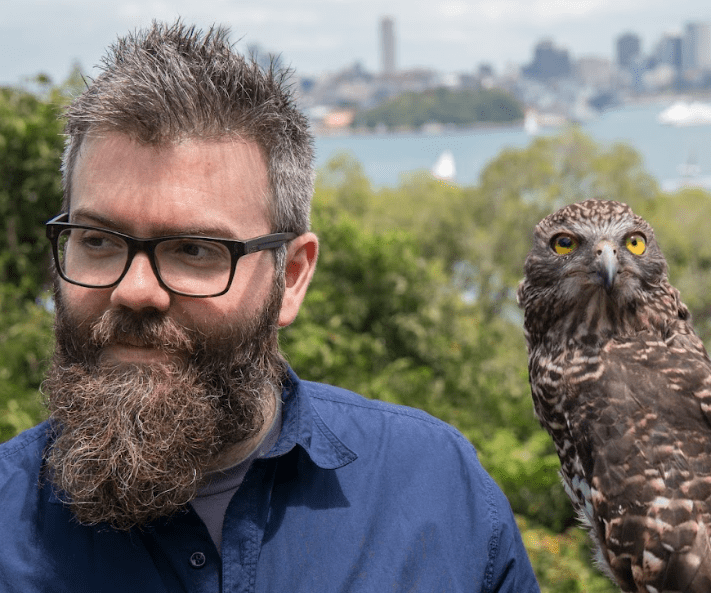
Joseph Asphahani is an avid video gamer, effective high school teacher, and enthusiastic candidate for whatever sort of cybernetic limb enhancement your mega-corp is planning for the inexorable dystopian future. When he’s not getting hopelessly lost in simulated worlds he’s often dreaming up worlds of his own. He resides in Chicago with his wife and two children.
Q&A
What inspired you to start writing in general?
I would say probably my high school creative writing teacher. His name was Mr. Bill Myers, and he still does storytelling in Ottawa, IL, but he’s retired from high school teaching now. He was a really interesting character with his own stories to tell, and I was inspired to make use of this imagination I was born with.
Also, I played a lot of Dungeons & Dragons with friends. When I was in high school, we were just doing home-brew stuff, we didn’t buy the packaged campaigns or anything, so we were creating worlds and making characters to live in those worlds.
That’s actually sort of the origin for my first book. I had made animal creatures for a campaign, like fox rogues and turtle wizards and hyena barbarians. But you know, as is typical with D&D groups, no one actually played the game after I’d made all this stuff, so I thought, I’ll just make it into a book.
What inspires you to continue writing?
I just think cool stuff inspires me. Just the beauty of the things I see in a movie or video game. I imagine in my own head being in these cool worlds or seeing these interactions or set moments, and I can transfer those little pieces that I see into the stories that I want to tell.
When did you know you wanted to publish a book, and how did you first get published?
That’s a tough one. I think I started writing The Animal in Man around 2004. I just started putting words on a page and I probably got to around 30,000 words and thought of it as a little side project. I thought, “I don’t have time for this. I’m a high school teacher. I’m never going to finish this.”
So I did this for years, and the story never really got anywhere. I didn’t have an actual story. Around 2013 or 2014, I joined a website that’s essentially Kickstarter but for books, and they ran contests. If you could get the top amount of pledges then they would fund the publishing.
I worked my ass off for a month, probably got barely any sleep, contacted everybody I ever knew to ask them to just give me twenty bucks and they’d get a copy of my book when it was done. So I ended up winning.
I was like oh shit, now I have to actually finish the book! That lit a fire under me, and I just typed my little heart out for probably a year at least. I actually finished both part one and part two at the same time, because it was meant to be one standalone story.
However, over the course of the publishing process, my publisher didn’t want to put out the book in its full form. They made me cut it in half, so then I had to make a new ending for part one and a new story arc. That first publisher only ever put out book one, Violent Mind. They didn’t want to put out book two.
I wanted to tell the whole story, so I eventually left that publisher and had to shop around for a new publisher. I did end up finding another publisher who did part two, and actually they want to do a part three, so I have sketched out everything for that.
What is your writing routine?
For me, it’s like feast or famine. I’ll go weeks without committing a single word to the page, and then in two days I’ll crank out 10,000 words. It’s all spontaneous. I’ll work on it and then tire myself out and hibernate again for a little while. But I don’t have writer’s block; I’m always ready at any given moment. I just have to feel that spark, and I don’t doubt myself as I’m writing.
What’s the best writing advice you’ve ever received?
The best advice I ever received wasn’t something I asked for, it was something I heard on NPR’s This American Life podcast. They said you need to trust your own taste. You have a sense of what’s enjoyable or good, so trust that.
As a storyteller, you have a story to tell, and you have to believe that what you’re trying to tell is cool. I know that the stories I have like locked and loaded in my imagination are cool as hell, and I think I’m good at visual storytelling and action, and showing not telling and all that kind of stuff. That’s why I don’t have writer’s block is because I know that the stuff I’m writing is good.
Now, that’s not to say that I’ve never started a project where I then discovered along the way I didn’t like it. I put in 20,000 words into a novel about a high school girl running underground Dungeons & Dragons groups during the 80s when everyone thought it was devil worship. I was probably trying to hit all of those popular tropes of the 80s with the popularity of Stranger Things, but I didn’t feel inspired by it, so I put it on the backburner.
Another good piece of advice is good writers are also good readers. You should be constantly reading books and trying to deconstruct the writing style of other authors that you enjoy, but also don’t be afraid to throw a book against the wall. If you’re not enjoying it, then stop reading. It’s perfectly fine to not finish the story.
It’s the same with writing. if I need to abandon a project, I’m not going to feel guilted into seeing it through and wasting time with it. There’s only so much time to do anything, so why keep doing that?
Do you have any advice for aspiring authors?
Trust your taste, and write every day, even though I don’t follow that. No one’s born great at anything, and it takes hard work and practice to become good at something, so saying write every day is basically saying, practice.
Fake it until you make it, keep working, practice, and hard work really does pay off. Also, have confidence in yourself.
Which books or authors have most influenced your writing?
In high school, I read a lot of R.A. Salvatore, which he writes these Dungeons & Dragons, forgotten realms books. His dark elf trilogy was extremely inspirational for me. I love the way Salvatore writes action scenes. He would describe every movement of a sword fight, they would last for five pages.
Also, I love the Witcher series, which I was introduced to the books through playing the video game. I got lost in that world. I especially like what the author does with dialogue, where even while two characters are having a conversation, you can still in see what they’re doing in your imagination.
Then another author that’s very influential for me is Joe Abercrombie. He does dark fantasy, and it’s really gritty and grim and bloody and violent, it’s not happy stuff. The main characters usually lose everything to get what they thought they wanted. It’s so good.
Then I recently discovered this author, Naomi Alderman. I just got the audiobook called The Power, and I was hooked, it was like a magic spell.
I recently read another book of hers called The Future, which is about trying to navigate today’s world with these oligarchs and billionaires controlling everything, and there’s also an AI system. It was great.
What’s something readers might be surprised to learn about you?
I don’t write full-time. I’m a high school teacher teaching English and special ed. I used to be solely an English teacher in inner city Chicago, and that was a very tough neighborhood I taught in. It really opened my eyes to human suffering and systemic racism. I think we’re all only one race, the human race, so we have to find a way to move forward as one.
Now I’m working in the suburbs of Chicago where I see the other side of it, the affluence instead of destitute poverty. But the thing is, kids everywhere are the same at their core. Every teenager deep down is the same, whether they come from a rich or poor background.
What are you currently writing? Anything coming out soon?
I wish I could say I’m working on The Animal in Man book three, but that is not true. I’ve sidelined it because I’m writing this other standalone book called The Koa, which is about political violence in a near future dystopia with an AI surveillance system.
It’s been fueled by my anxieties over recent elections and recent turmoil caused in the wake of elections and all of this stuff going on right now with immigration, tariffs, snap benefits, affordable healthcare, etc.
All of this turmoil in our country that’s been going on has led me to like envision what our country is going to look like in the year 2044. If and when people snap and they find the line, so to speak, where they just cannot cross anymore and things get really violent really fast, what if it was fueled by this omnipotent AI, like an AI that is self-aware and is smarter than a human. One that is actually online and plugged into everything that we we’ve ever touched.
Whatever version of the world comes out the other side of this, would the AI be there to see us through and protect us, or would it ultimately be leading us to our end?
So that’s the new project I’m working on.
Connect with Joseph
Check out Joseph’s books and other projects on his website josephasphahaniwrites.com. You can find his books wherever books are sold. Consider purchasing them from Bookshop.org to support independent bookstores and help sustain this blog. (Affiliate link; I may earn a small commission at no extra cost to you.)
Wrapping Up
What struck me most about this conversation was Joseph’s deep trust in imagination, both as a creative force and as a way of understanding the world. From building Dungeons & Dragons campaigns that eventually became novels, to grappling with big questions about power, violence, and AI in his current work, his stories are rooted in curiosity and conviction.
Whether you’re an aspiring writer looking for permission to trust your instincts, or a reader interested in how fantasy and dystopian fiction reflect the world we’re living in now, I hope this interview offered insight and inspiration. Be sure to keep an eye out for The Koa and future installments of The Animal in Man, and as always, thank you for reading and supporting Notes from the Shelf.
Check out More Conversations with Authors
Love what you’re reading here? Support the blog and fuel my next cozy reading session by buying me a coffee.
 Notes from the Shelf
Leave a comment